Posted on: February 9, 2026 by Ahmed Saleem
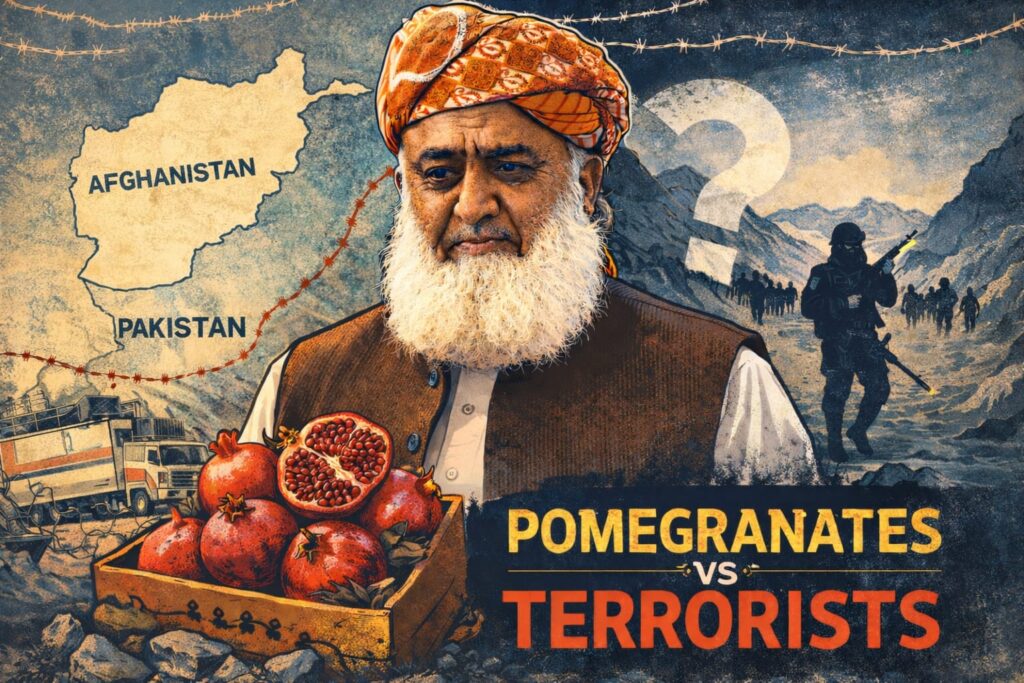
How narrative is manufactured in politics is rarely complicated, it is systematic. Take the viral line, “If pomegranates cannot cross, how can terrorists cross?” It works because it feels intuitive, it gives the audience a simple image, it offers instant certainty, and it flatters the listener into thinking they have spotted a contradiction. But it is a rhetorical trick, not a factual argument. Legal trade runs through choke points, customs, documentation, inspection, taxation. A border closure can halt thousands of trucks overnight. Irregular movement is the opposite, it needs only a few successful crossings, it leverages terrain, informal routes, and human networks across a long and rugged frontier. The state may control gates yet still face infiltration, that is precisely why border management is expensive, technical, and continuous.
The second move is frame-shifting. Instead of engaging Pakistan’s security claim, the argument tries to put Pakistan itself in the dock, “Why does Pakistan have bad relations with every Afghan government?” The trick here is to replace a specific, testable issue, cross-border terrorism, with a broad moral judgement, “you always fail with everyone.”
Pakistan is not the only actor with agency. There is a deep history of Afghan policies and narratives that have kept ties brittle, including early linkage of relations with the Pashtunistan question, Kabul’s opposition to Pakistan’s UN admission in 1947, and repeated disputes around the Durand Line, a dispute that has fuelled nationalist politics across regimes.
A third technique is selective memory. Political storytellers pick the parts of history that serve today’s punchline and discard the rest. Border closures that damage fruit exports become “proof” of a sealed frontier, while the well-documented existence of informal crossings and borderland survival economies is ignored.
Finally comes moral substitution, trading evidence for emotion. A clever metaphor is offered instead of operational facts, who crossed, how, through which gaps, with what enabling networks, what enforcement failed, what coordination is missing, what bilateral mechanism is needed.
The antidote is simple. When a line goes viral, ask four things, what is being compared, is it comparable, what facts would prove or disprove it, and what important realities were left out. In a region where there is a tendency to be selfish, myopic and polarised, the public deserves arguments anchored in verifiable realities, not metaphors engineered for applause.
Author:
Ahmed Saleem is a freelance writer with an academic background in literature, with a professional focus on structured, research-oriented, and analytical writing.
Contact: ahmed.saleem35089@gmail.com